Coolest Places to Visit in Costa Rica – I’ll be honest with you — Costa Rica wrecked me in the best possible way. I showed up expecting beautiful beaches and left questioning why I hadn’t moved there already. The coolest places to visit in Costa Rica aren’t always the ones on the first page of a Google search, and that’s exactly why this guide exists.
Whether you’re planning your first trip or your fifth, this is the resource I wish I had before I booked my flights. We’re talking real neighborhoods, honest prices in U.S. dollars, crowd-avoidance tricks, and the kind of advice you only get from someone who’s actually stood there, sweating, with sand in their shoes, trying to figure out where to eat.
Coolest Places to Visit in Costa Rica Oveview
| Detail | Info |
|---|---|
| Country | Costa Rica |
| Nearest Major Cities | San José (capital), Liberia (gateway to Guanacaste) |
| Official Language | Spanish (English widely spoken in tourist areas) |
| Currency | Costa Rican Colón (CRC) — but USD is accepted almost everywhere |
| Time Zone | Central Standard Time (CST) — UTC-6, no daylight saving |
| Visa Requirements | Americans get 90 days visa-free with a valid passport |
| Best Duration of Stay | 10–14 days to hit the highlights; 7 days if you stay in one region |
When to Go: Seasonal Travel Breakdown
| Month / Season | Weather | Crowd Level | Best For |
|---|---|---|---|
| December – April | Dry, sunny, low humidity | High (peak season) | Beach trips, Pacific coast, first-timers |
| May – June | Starts raining, still warm | Medium | Budget travel, green landscapes, fewer tourists |
| July – August | Wetter, brief dry spells (“veranillo”) | Medium-High | Families, whale watching, Caribbean coast |
| September – October | Rainiest months, lush rainforests | Low | Budget deals, birdwatching, adventurous solo travelers |
| November | Transitioning to dry season | Low-Medium | Shoulder season sweet spot — great prices, improving weather |
The dry season runs December through April and that’s when airfare and hotels spike. If you can swing a trip in May or early June, you’ll save 30–40% on accommodations and find the waterfalls running at full force.






The Coolest Places to Visit in Costa Rica, Ranked and Best
1. Monteverde Cloud Forest: The Place That Genuinely Changed How I See Nature
Monteverde is not what most Americans picture when they think Costa Rica. There’s no ocean here. Instead, you’re up in the mountains at about 4,600 feet, walking through cloud forest where the mist rolls in like something out of a fantasy novel.
The Santa Elena Cloud Forest Reserve and the Monteverde Cloud Forest Biological Reserve are the two main options. The Santa Elena reserve is run by a local school and tends to have lighter crowds — I’d go there first thing in the morning and then hit Monteverde later. The difference in atmosphere is remarkable.
Zip-lining in Monteverde isn’t just “zip-lining.” The canopy tours here send you across 13 cables stretching over a kilometer each, 200 feet above the forest floor. If you’ve zip-lined before and thought it was fine, this will recalibrate your expectations entirely.
Quetzal sightings are possible January through May during breeding season. I’m telling you this not to get your hopes up but to tell you not to go without a local guide if seeing one matters to you. Guides charge around $25–$40 per person and know exactly where to look.
Budget around $70–$100 per day including a mid-range hotel, entrance fees, and meals. Most restaurants in town run $8–$15 per plate.
2. Manuel Antonio: The Best Place to Visit in Costa Rica for First-Timers and Families
Manuel Antonio National Park is probably the most famous spot in the country, and for once, the hype is completely justified. It packs white sand beaches, coral reefs, and primary rainforest into 7 square miles. You will see monkeys. Multiple kinds. Possibly within five minutes of arriving.
The trick most travelers miss: get there when the gates open at 7 a.m. By 10 a.m., the beaches are packed and the wildlife retreats. That two-hour window between 7 and 9 a.m. is when the sloths are still hanging low in the trees near the entrance trail, the capuchins are crossing the path to the beach, and you have Playa Manuel Antonio practically to yourself.
Park admission is $20 per adult for foreigners. You must book your ticket online in advance at the SINAC website — they cap daily visitors and the park sells out, especially December through March.
The town of Quepos, about 4 miles away, is where you want to eat and stay. It’s cheaper than the hotel zone right near the park entrance and has genuinely good local spots. Soda Sanchez is where I had the best casado — a traditional plate of rice, beans, meat, and salad — for about $6.
This is one of the best places to visit in Costa Rica with family because the beach is calm, the trails are manageable for kids, and the wildlife does most of the entertainment work for you.
Have you taken kids to Manuel Antonio? I’d love to know how old they were and whether they were obsessed with the monkeys as much as I was — drop it in the comments.
3. Arenal Volcano: Hot Springs, Lava Views, and the Best Base for Adventure
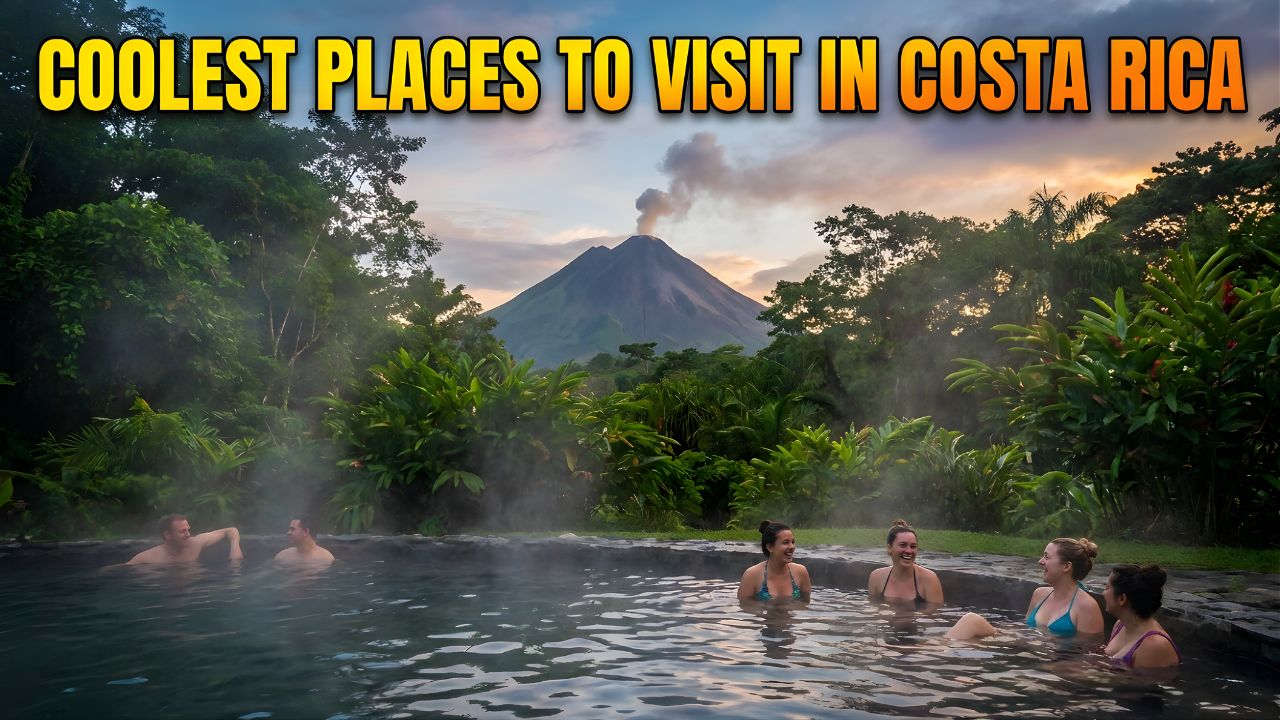
La Fortuna de San Carlos is the town you’ll base yourself in for Arenal, and it’s one of the best places to visit in Costa Rica on the Pacific side — even though technically it’s inland. The volcano itself is one of the most active in the Western Hemisphere, and on a clear night, you can watch lava glow from certain viewpoints.
The hot springs here are legendary. Tabacón Grand Thermal Resort charges around $100 for day access, which sounds steep but includes multiple pools, a swim-up bar, and direct views of the volcano. If that’s outside your budget, Baldi Hot Springs runs about $35 per person and is still genuinely beautiful.
For the adventure crowd: the Arenal area has white-water rafting on the Balsa and Toro Rivers, mountain biking through lava fields, and the hanging bridges at Mistico Park, which give you treetop views without needing to zip-line.
One thing I’ll flag — the volcano is frequently cloud-covered. There’s a saying locally: “Arenal plays hide and seek.” Plan at least two nights in La Fortuna to give yourself two chances at a clear view. If you only go for one night and it’s socked in, you’ll regret it.
4. The Osa Peninsula and Corcovado: For People Who Want the Real Jungle
National Geographic once called Corcovado “the most biologically intense place on Earth.” That’s not marketing copy. It’s one of the last remaining patches of lowland tropical rainforest in Central America, and it contains roughly 2.5% of the world’s biodiversity in an area the size of Rhode Island.
Getting there takes effort. You fly or take a boat from Drake Bay, or you hike in from La Leona or Los Patos ranger stations. There are no roads through the park. That’s the entire point.
You cannot enter Corcovado without a certified guide. Full stop. This is a legal requirement, not a suggestion. A licensed day tour runs about $100–$150 per person and a multi-day camping trip inside the park can run $300 and up. Worth every dollar if wildlife is your thing — tapirs, scarlet macaws, four species of monkey, harpy eagles, and jaguar tracks are all genuinely possible here.
Stay in Drake Bay for the best mix of access and comfort. It’s remote but has solid lodges ranging from $80 to $200 per night.
This is not a destination for casual travelers or anyone with mobility limitations. But if you’re the kind of person who reads about a place called “the most biologically intense place on Earth” and immediately wants to go — the Osa Peninsula is your people.
5. Tamarindo and the Nicoya Peninsula: Cool Places to Visit in Costa Rica on the Pacific Coast
Tamarindo is the surf town that somehow stays cool even though everyone knows about it. It sits on the Guanacaste coast in the northwest, gets over 300 days of sun per year, and has a vibe somewhere between laid-back beach town and lively expat hub.
Learning to surf here is genuinely achievable for beginners. Tamarindo’s beach break is forgiving, lessons run $50–$70 for a two-hour group session, and within two days most people are at least standing up. I was not graceful about it. I was very enthusiastic though.
Beyond surfing, the Nicoya Peninsula has some of the most interesting ecological zones in the country. Ostional Wildlife Refuge, about an hour south, is where Olive Ridley sea turtles mass nest in a phenomenon called an “arribada.” Tens of thousands of turtles come ashore at once, mainly July through December. Watching it is one of those experiences that you don’t fully believe until you’re standing there.
Nosara, another Nicoya town, is where yoga retreats and organic smoothie bars outnumber souvenir shops. It’s quieter, more upscale, and genuinely beautiful. Hotels in Nosara average $150–$250 per night — compared to Tamarindo where you can find decent places at $80–$120.
6. Puerto Viejo and the Caribbean Coast: The Side of Costa Rica Most Americans Skip
This is the one. If you want a piece of Costa Rica that feels nothing like everywhere else you’ve been — go to the Caribbean coast.
Puerto Viejo de Talamanca has a completely different culture from the Pacific side. The food is Afro-Caribbean: rice and beans cooked in coconut milk, jerk chicken, fresh ceviche, and patacones that will make you want to cry because you know you’re going home eventually. Soda Miss Lizzy and Bread and Chocolate are two spots I’d go back to tomorrow if I could.
The beaches here — Playa Cocles, Playa Chiquita, Manzanillo — are some of the prettiest in Central America and genuinely uncrowded compared to the Pacific side. Manzanillo National Wildlife Refuge at the end of the road is a protected jungle-meets-beach area where you can snorkel alongside dolphins.
Getting there is part of the commitment. From San José, it’s a 4-hour drive (or a 1-hour flight to Limón followed by a taxi). The road quality varies. The reward is completely worth it.
This is one of the best places to visit in Costa Rica on the Caribbean side and it’s dramatically underrated in most travel guides aimed at American tourists. Go before everyone else figures this out.
What’s your experience with the Caribbean coast versus the Pacific? I’ve met travelers who go once and never look back — I’d genuinely love to hear your take in the comments.
7. San José: Don’t Write It Off Before You Give It a Day
Most travel guides tell you to blow through San José as fast as possible. I’d push back on that slightly. The capital has neighborhoods worth a half day at minimum.
Barrio Escalante is where you eat dinner — a walkable strip of restaurants, wine bars, and coffee shops that wouldn’t feel out of place in Brooklyn. Kalu restaurant is the go-to for elevated Costa Rican cuisine. Sikwa is worth a reservation if you can get one — it’s indigenous-inspired tasting menu food, which sounds niche but is extraordinary.
The Jade Museum (Museo del Jade) is one of the best pre-Columbian artifact collections in all of Central America and most Americans have never heard of it. Admission is about $18 and it takes two hours to properly walk through.
For most trips, one night in San José on the front end (or back end) of your trip is the right call. It’s not the highlight, but dismissing it entirely means missing a city that’s genuinely interesting when you know where to look.
Is $1,000 Enough for a Week in Costa Rica?
Yes — but it requires planning and honest expectations. A $1,000 budget for one week breaks down roughly like this:
- Accommodation: Budget hostels and guesthouses run $25–$50 per night = $175–$350 for 7 nights
- Food: Eating at sodas (local diners) keeps meals at $5–$10 = $35–$70 per day, so $245–$490 for the week
- Activities: Pick 2–3 paid experiences. National park entry ($20), a canopy tour ($50–$80), and a guided hike ($30–$50) add up to $100–$150
- Transportation: Shared shuttles between towns run $25–$50 per leg
This gets tight but doable if you’re disciplined. Skip the luxury hot springs. Cook one or two meals yourself if you have access to a kitchen. Take the shared shuttle instead of private transfers. Stick to one region instead of trying to see the whole country.
If your budget is $1,500 per week, Costa Rica opens up considerably and you can do it in real comfort.
How to Get Around Costa Rica Without Losing Your Mind
Costa Rica’s road system is… character building. Google Maps is your friend but it will take you down roads that require a 4×4. Here’s what actually works:
- Shared shuttles: Companies like Interbus and Gray Line run fixed routes between all major tourist hubs. A Monteverde to La Fortuna shuttle is about $40. Book through your hotel or directly on their websites.
- Renting a car: Best if you want full flexibility. A 4×4 is worth the extra $20–$30/day. Stick with well-reviewed companies — Budget and Adobe Car Rental are reliable. Avoid tiny local operators with no insurance clarity.
- Public buses: Extremely cheap ($1–$8 per trip) and slow. The San José to Manuel Antonio TRACOPA bus is a classic and totally fine if you’re not in a rush.
- Domestic flights: SANSA and Sky Airline connect San José to most major destinations for $80–$180. Flying to Puerto Jiménez (Osa Peninsula) or Quepos (Manuel Antonio) saves serious time.
What to Know Before You Go (Safety, Health, and Practical Tips)
Costa Rica is one of the safest countries in Latin America for American travelers. That said, petty theft is real — don’t leave anything visible in a rental car, and use your hotel safe.
Check the U.S. State Department’s travel advisory page at travel.state.gov before you fly. Costa Rica typically sits at Level 1 (Exercise Normal Precautions), though specific areas near the Caribbean border warrant more attention.
For health, no required vaccinations exist specifically for Costa Rica, but the CDC recommends being current on routine vaccines and considering Hepatitis A if you’re eating at local markets or sodas. Check the CDC Travelers’ Health page for Costa Rica for updated guidance before your trip.
A few practical notes:
- Tap water is safe to drink in most of the country, including San José and major tourist areas. Check locally in remote regions.
- Credit cards are widely accepted in tourist areas. Carry some cash in colones or USD for small sodas, markets, and taxis.
- Tipping is appreciated but not mandatory — 10% is standard at restaurants that don’t already include a service charge.
Coolest Places to Visit in Costa Rica FAQ
Q : Where is the coolest part of Costa Rica?
Ans – It genuinely depends on what “cool” means to you. For pure natural experience, the Osa Peninsula and Corcovado National Park are unmatched. For the combination of beaches, wildlife, and accessibility, Manuel Antonio wins. For unique culture and vibe, the Caribbean coast around Puerto Viejo is unlike anything else in the country.
Q : What is the 183-day rule in Costa Rica?
Ans – This refers to Costa Rica’s residency tax rule — if you spend 183 days or more per year in Costa Rica, you may be considered a tax resident and subject to local income tax laws. For most American tourists visiting for a week or two, this doesn’t apply at all. It becomes relevant for retirees, remote workers, or expats considering longer stays. Consult a local attorney if you’re planning an extended move.
Q : What is the coolest thing to do in Costa Rica?
Ans – Watching the sunrise over Arenal Volcano from a hot spring is hard to beat. So is snorkeling with whale sharks off the Osa Peninsula or walking through Monteverde cloud forest at dawn. If you pushed me, I’d say the Corcovado guided hike — because it’s the kind of thing you talk about ten years later.
Q : Is $1,000 enough for a week in Costa Rica?
Ans – Yes, but you’ll need to travel lean — budget accommodations, local sodas for meals, shared shuttles, and selective activities. If you add flights from the U.S., that eats into this budget significantly. Think of $1,000 as your in-country budget, not total trip cost.
Q : What is the prettiest part of Costa Rica?
Ans – The Nicoya Peninsula at sunset is stunning. The cloud forests of Monteverde have an otherworldly quality that photos don’t capture properly. But the Caribbean beaches near Manzanillo — with their jungle-backed shores and crystal water — might be the most purely beautiful scenery in the country. The honest answer is that this country is relentlessly, unfairly pretty almost everywhere you look.
Final Thoughts: Book the Trip
Costa Rica is one of those destinations that delivers every time, for almost every type of traveler. Solo adventurers, families, honeymooners, retirees — the country genuinely has something real for all of them.
The coolest places to visit in Costa Rica are the ones that match who you actually are as a traveler. Hate crowds? Head to the Osa. Love surf culture? Tamarindo is waiting. Want to show your kids something that makes them forget their screens for a week? Manuel Antonio will do it in an afternoon.
Pick your region, book your flights, get the 4×4, and go. You’re going to come back wanting to plan the next trip before you’ve even unpacked from the first one.
What part of Costa Rica are you most excited to visit? Or if you’ve already been — what’s the one thing you’d tell a first-timer to do that they probably won’t find in the guidebooks? Leave it in the comments. I read every single one.