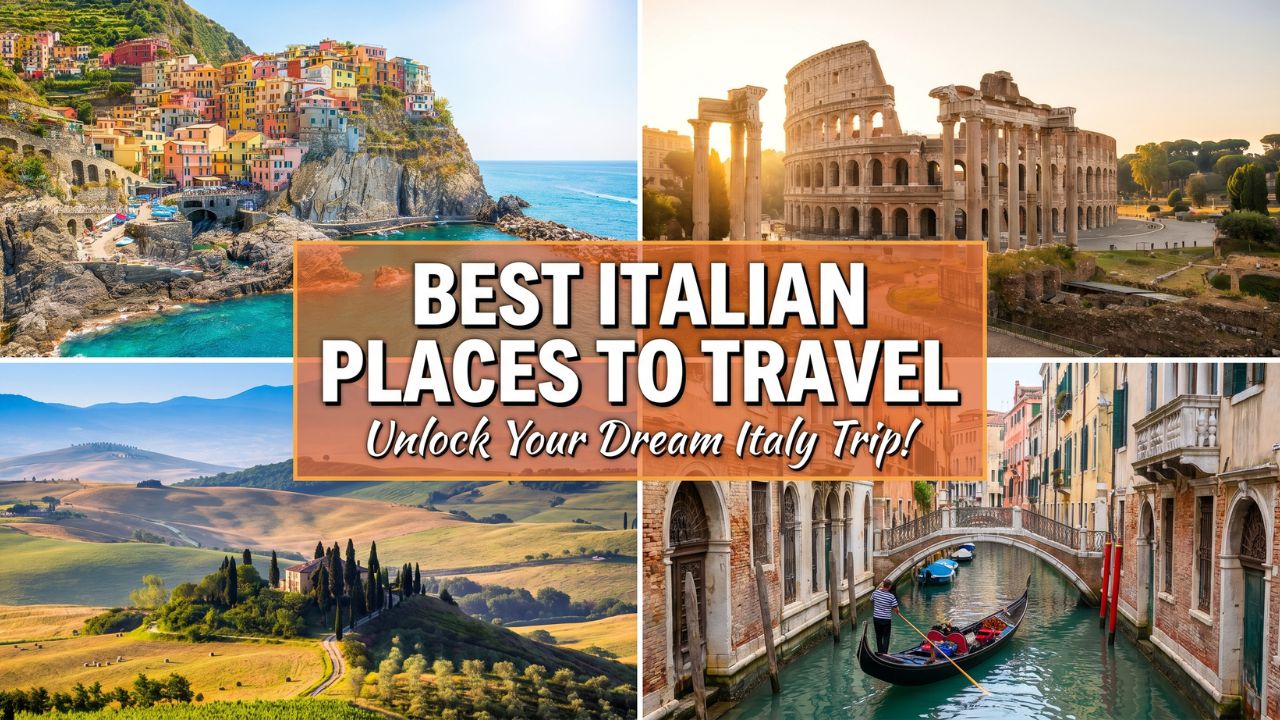
Best Italian Places to Travel : Italy has a way of getting under your skin before you even land. You’re still somewhere over the Atlantic, rewatching Cinema Paradiso on the plane’s tiny screen, and you’ve already mentally rearranged your entire life around a slow afternoon in Tuscany. I’ve been there — both on that plane and in that daze of deciding where to actually go once you arrive.
The problem with planning a trip to Italy is that every region, every city, every hilltop village deserves its own week. But most of us don’t have six months and an unlimited credit card. So this guide cuts through the “everywhere is beautiful” noise and gives you real, specific, boots-on-the-ground direction on the best Italian places to travel — broken down by what kind of traveler you are, what time of year you’re going, and yes, what your actual budget looks like.
Whether you’re mapping out the top 10 places to visit in Italy for a first trip, looking for the best places to go in Italy for couples, or hunting for something off-the-beaten-path in the north, this is your starting point.





Best Italian Places to Travel – Italy at a Glance
| Detail | Info |
|---|---|
| Country | Italy (Repubblica Italiana) |
| Capital | Rome |
| Language | Italian |
| Currency | Euro (€) — approx. $1.08 USD per €1 (always check current rate) |
| Time Zone | CET (UTC+1); CEST in summer (UTC+2) |
| Visa for Americans | No visa needed for stays up to 90 days (Schengen) |
| Best Duration | 10–14 days for a solid first trip; 3 weeks to go deeper |
| Airports | Rome Fiumicino (FCO), Milan Malpensa (MXP), Venice Marco Polo (VCE) |
Why Italy Still Hits Different Every Single Time
I’ve been to Italy four times now. Each trip, I told myself I’d finally “do it properly” — meaning see the Sistine Chapel without elbowing strangers, find a trattoria where locals actually eat, and not pay €6 for a cappuccino near the Colosseum.
Some of those goals I nailed. Others, not so much.
But here’s what I keep learning: Italy is not a destination you conquer. It’s one you surrender to. The food alone will reroute your plans. You’ll walk into a market in Bologna intending to spend 20 minutes and walk out two hours later with a chunk of aged Parmigiano and a new philosophy about lunch.
The best places to visit in Italy for the first time are almost always the classics — Rome, Florence, Venice, Cinque Terre — and for good reason. But Italy’s second layer is where things get genuinely interesting. The places where you’re not competing with 200 other tourists for the same Instagram angle.
This guide covers both. The icons and the quiet alternatives that most first-timers never find.
What is The Best Time to Visit Italy
Timing your trip to Italy matters more than most people realize. “Peak season” isn’t just expensive — it actively changes your experience of many places.
| Month/Season | Weather | Crowd Level | Best For |
|---|---|---|---|
| January–February | Cold (35–50°F); occasional snow in north | Very low | Budget travelers, Venice Carnival (Feb), ski trips |
| March–April | Mild (50–65°F); some rain | Low–moderate | Spring blooms, fewer crowds, shoulder-season prices |
| May | Warm (65–75°F); pleasant | Moderate–high | Arguably the best all-around month in Italy |
| June–August | Hot (80–95°F+); humid in south | Very high | Beach trips, outdoor festivals, long daylight |
| September–October | Warm (65–80°F); excellent light | Moderate | Harvest season, wine country, perfect for couples |
| November | Cool (45–60°F); some rain | Low | Truffle season, authentic local life, off-season deals |
| December | Cold (35–50°F); Christmas markets | Moderate (holiday spike) | Festive atmosphere, Christmas markets, cozy food season |
My honest recommendation for most Americans: Go in May or September. The weather is ideal, the light is extraordinary (photographers, take note), and you’re not sharing every piazza with 10,000 other tourists. September also coincides with grape harvest season in Tuscany and Piedmont, which is one of the most atmospheric times to be in Italy.




Top Places to Visit in Italy: 15 Destinations Worth Your Time
1. Rome — The Eternal City That Never Gets Old
Rome is the obvious starting point, and it earns every cliché written about it.
The Colosseum, the Roman Forum, the Pantheon, Vatican City — these are legitimately among the most extraordinary human-made things on Earth. Don’t let the tourist crowds talk you out of being genuinely moved by them.
What most guides skip: The Aventine Hill neighborhood, specifically the Orange Garden (Giardino degli Aranci), has one of the best views of St. Peter’s dome in the city — and almost no one is there. Walk through the Knights of Malta keyhole on the Piazza dei Cavalieri di Malta for a framed view of the Vatican that feels almost surreal.
The Trastevere neighborhood is where I always end up at night. It’s lively, walkable, and still has restaurants where a full dinner with wine won’t cost you $100 per person.
Getting around Rome: Don’t bother with taxis from the airport unless you’re exhausted. The Leonardo Express train from Fiumicino to Roma Termini runs every 15 minutes and costs about €14. Worth every cent.
Budget note: Skip the overpriced cafes in tourist zones. Cross one or two streets away from any major monument and prices drop significantly. A proper Roman suppli (fried rice ball) from a street vendor should cost under €2.
2. Florence (Firenze) — Where Every Street Is a Gallery
Florence is the kind of city that makes you feel cultured just by walking through it.
The Uffizi Gallery houses Botticelli’s Birth of Venus and Primavera, Michelangelo’s David is at the Accademia, and the Duomo (Cathedral of Santa Maria del Fiore) dominates the skyline in a way that feels both enormous and impossibly graceful.
Book the Uffizi and Accademia tickets at least 2–3 weeks in advance, especially in summer. I learned this the hard way, standing in a three-hour line in July heat, watching everyone else with pre-booked tickets walk right in.
Hidden gem: The Oltrarno neighborhood (literally “across the Arno”) is Florence’s cooler, less touristy side. Better food, better prices, and the Pitti Palace is there anyway. The Boboli Gardens behind the palace are a genuine escape from the city’s intensity.
For couples: Climb the Piazzale Michelangelo steps at sunset. Yes, it’s listed in every guidebook. It’s listed because it works — the panoramic view of Florence at golden hour is genuinely breathtaking and surprisingly romantic even with company.
Florence is one of the undisputed top 3 places to visit in Italy for first-timers, and it absolutely deserves that reputation.
3. Venice — Yes, It’s Worth It (If You Do It Right)
Venice is simultaneously the most photographed and most misunderstood city in Italy.
Most people do Venice wrong. They arrive in the morning via day cruise or bus tour, clog the Rialto Bridge for photos, eat mediocre food near San Marco, and leave by 4 PM wondering what the fuss was about.
Do this instead: Stay overnight. Venice completely transforms after 6 PM when the day-trippers leave. The narrow calli (alleyways) go quiet. The canals reflect lamplight. You can walk across the entire city without bumping into anyone. That Venice — the nighttime, stay-over Venice — is one of the most magical places I’ve ever stood.
The Dorsoduro and Cannaregio neighborhoods have more authentic restaurants and far fewer tourists than the San Marco area. Seek them out for dinner.
Getting there: The water taxi from Venice Marco Polo airport is expensive (~€110–€130 for the whole boat). The public ACTV bus to Piazzale Roma plus a vaporetto is a fraction of the cost and perfectly easy.
For first-timers: Yes, a gondola ride is touristy and overpriced (~€80 for 30 minutes). But the traghetto — the public gondola ferry that crosses the Grand Canal at several points — costs €2 and gives you the same experience. Take the traghetto.
4. The Amalfi Coast — One of the Best Places to Go in Italy for Couples
The Amalfi Coast is pure visual drama. Pastel-colored cliffside villages tumbling toward turquoise water, winding coastal roads, lemon trees everywhere.
It’s also genuinely difficult to navigate, which is part of why I love it — it filters out the least committed tourists.
Positano is the Instagram darling and worth seeing, but stay in Praiano or Furore if you want the same coastal beauty at 30–40% lower prices. Praiano especially has a local, lived-in feel that Positano has largely lost.
Getting around: Renting a car on the Amalfi Coast sounds romantic until you’re white-knuckling a hairpin turn while a tour bus tries to pass you. Take the SITA Sud buses or the ferry between towns. The ferry from Amalfi to Positano is one of the best value 30-minute boat rides in Europe.
For couples specifically: Book dinner at a restaurant with a terrace view for one evening and don’t worry about the price. A candlelit dinner overlooking the Tyrrhenian Sea is the kind of thing you’ll talk about for years.
5. Cinque Terre — The Five Villages That Earned Their Fame
The Cinque Terre — five coastal villages linked by trails and trains — is one of the most iconic stretches of Italian coastline, and one of the most crowded in summer.
The five villages are Monterosso al Mare, Vernazza, Corniglia, Manarola, and Riomaggiore. Vernazza and Manarola are the most photographed. Monterosso is the most beach-friendly. Corniglia is the quietest (it’s perched on a cliff with no direct sea access).
Timing tip: Go in late September or October. The crowds are dramatically thinner, the light is warmer, and the hiking trails (some closed in peak summer heat) are fully open. The classic Sentiero Azzurro (Blue Trail) connecting the villages is best walked in cooler temperatures anyway.
Budget warning: Cinque Terre is not cheap. The Cinque Terre Card (required for trail access and unlimited train rides between villages) runs about €18–€30 depending on options. Budget €80–€120/day per person for food, accommodation, and activities here.
Have you been to Cinque Terre in the shoulder season? I’d genuinely love to know which village you stayed in — drop it in the comments.
6. Tuscany — The Countryside That Looks Like a Painting
Tuscany isn’t one place — it’s an entire world. Florence is its capital, but the soul of Tuscany is in the rolling Val d’Orcia landscape, the medieval hill towns, and the wine cellars of Chianti.
Siena is the other great Tuscan city and often skipped by itineraries that go straight from Florence to Rome. Don’t skip it. The Piazza del Campo is one of the finest medieval squares in Europe, and the city’s Gothic Duomo gives Florence’s a genuine run for its money.
San Gimignano is the “city of towers” — a perfectly preserved medieval hill town about 30 minutes from Siena. Arrive early (before 10 AM) or late (after 4 PM) to dodge the tour buses.
Pienza, Montalcino, and Montepulciano form a triangle of hilltop wine towns in the Val d’Orcia. This is where you drink Brunello di Montalcino and Vino Nobile di Montepulciano in the actual cellars where they’re made.
For drivers: Renting a car is the only real way to explore rural Tuscany. The SS2 highway and the scenic Strada del Vino (Wine Road) routes between hill towns are among the most beautiful drives in the world. Budget for ZTL zones (restricted traffic zones) in historic centers — fines can arrive in the mail months after your trip.
7. Milan — Italy’s Fashion-Forward North
Milan is Italy for people who thought they didn’t like Italy.
It’s modern, fast-paced, expensive, and obsessed with design and food in equal measure. The Duomo di Milano is one of the largest Gothic cathedrals in the world — more than 500 years in the making, with 3,400 statues decorating its exterior. Go up to the rooftop terraces for a perspective that makes the street-level view look ordinary.
The Last Supper: Leonardo da Vinci’s Cenacolo (The Last Supper) is housed in the refectory of Santa Maria delle Grazie. This requires booking months in advance — I mean that literally. Slots sell out 3–4 months ahead in peak season. Book at https://www.vivaticket.com the moment your travel dates are confirmed.
For shoppers and designers: The Brera and Navigli neighborhoods are Milan’s most liveable, with independent boutiques, aperitivo bars, and canal-side restaurants. The Quadrilatero della Moda (fashion quadrilateral) around Via Montenapoleone is where the luxury flagships are — window-shopping is free.
Milan is a key gateway for exploring northern Italy, making it one of the essential top 10 places to visit in northern Italy for any comprehensive itinerary.
8. Lake Como — Where the Rich Go to Feel Richer (And You Can Too)
Lake Como is 45 minutes by train from Milan and looks like someone took a postcard and made it real.
Surrounded by Alps, dotted with elegant villas, and reflecting perfectly clear water, Lake Como is expensive by Italian standards — but you don’t have to spend Como prices to enjoy Como beauty.
Bellagio is the most famous village on the lake — deservedly so, though extremely crowded in summer. Varenna on the opposite shore is quieter, cheaper, and honestly just as beautiful. The ferry between the two towns runs frequently and costs just a few euros.
Villa Carlotta in Tremezzo has extraordinary botanical gardens open from April through October. In spring, when the rhododendrons and azaleas are blooming, it’s one of the most quietly spectacular places in Italy.
Budget tip: Stay in Lecco or Como city rather than lakeside villages. You’ll have easy ferry access to everywhere while saving 30–50% on accommodation.
9. Bologna — Italy’s Underrated Culinary Capital
If food is your primary reason for going to Italy — and honestly, it should be at least top three — Bologna needs to be on your list.
This is where ragù bolognese actually comes from (and bears no resemblance to the jarred pasta sauce). This is where mortadella was invented. This is the city with more miles of covered porticoes than anywhere else in the world, perfect for walking, eating, and then walking again.
Why Bologna is underrated: It’s a university city, meaning it skews local and lively without feeling manufactured for tourists. The Mercato di Mezzo food market in the historic center is the real deal — go for lunch, eat standing up, and spend under €15 for a meal that would cost €50 in Rome.
What to eat: Tagliatelle al ragù (not spaghetti bolognese — that’s not a thing here), tortellini in brodo, mortadella sandwich, and a glass of Pignoletto wine. In that order.
The city is also perfectly positioned between Florence and Venice on the high-speed rail line, making it an easy and rewarding stop.
10. Naples — The Most Alive City in Italy
Naples is chaotic, loud, occasionally overwhelming, and one of the most genuinely alive cities I’ve ever visited.
This is the birthplace of pizza. Not the concept — the actual, specific, UNESCO-recognized Neapolitan pizza with its charred crust, San Marzano tomatoes, and fior di latte mozzarella. Eating a margherita at Pizzeria Brandi (where the margherita was allegedly created for Queen Margherita of Savoy in 1889) or L’Antica Pizzeria da Michele is not a tourist activity — it’s a pilgrimage.
Beyond pizza: The National Archaeological Museum in Naples has the finest collection of Greek and Roman antiquities in the world, much of it excavated from Pompeii and Herculaneum. Plan 3–4 hours minimum.
Pompeii: Yes, go. The ancient Roman city frozen in 79 AD by Vesuvius’s eruption is 25 minutes from Naples by Circumvesuviana train and remains one of the most profound archaeological sites anywhere. Go early — by 9 AM — and you’ll have sections of the city almost to yourself.
Safety note: Naples has a reputation. Most of it is overstated. Normal urban awareness — don’t flash expensive cameras, watch your bag on the metro, avoid certain peripheral neighborhoods at night — applies here as it would in any major city. Check the U.S. State Department’s Italy travel advisory for current guidance.
11. Sicily — An Island That Feels Like Its Own Country
Sicily is Italy’s largest island and one of its most culturally complex — shaped by Greek, Arab, Norman, and Spanish influences over millennia.
Palermo, the capital, is a sensory overload in the best possible way. The Ballarò market in the morning, the mosaics of the Palatine Chapel, the wild mix of crumbling baroque buildings and street food stalls selling arancini and sfincione (Sicilian focaccia pizza). Budget €3–€5 for street food meals that are genuinely excellent.
Taormina is Sicily’s most famous resort town, perched above the sea with views of Mount Etna and a Greek theater that actually hosts performances in summer. It’s touristy, yes — but the views from the public garden above town at sunset are real.
Mount Etna: Europe’s most active volcano is climbable. Guided tours from Catania or Taormina take you to the crater area (around 10,000 feet). It’s one of the most unusual hiking experiences available in Europe — volcanic ash underfoot, steam venting nearby, views of the Mediterranean below.
12. The Dolomites — Northern Italy’s Alpine Drama
The Dolomites in northeastern Italy are among the most spectacular mountain landscapes on Earth — a UNESCO World Heritage site of pale limestone spires rising from green valleys.
This is Italy for people who didn’t think Italy did mountains. It absolutely does.
Cortina d’Ampezzo is the most famous resort town in the Dolomites — glamorous, expensive, and worth a night just to feel the atmosphere. For hiking, the Alta Via 1 trail system offers multi-day routes through the most dramatic terrain, with rifugi (mountain huts) providing accommodation and hot meals along the way.
Val Gardena is the best base for accessible day hikes with the most dramatic scenery. The cable car to the Seceda plateau deposits you in a landscape that genuinely looks like a fantasy painting.
Best time: Late June through September for hiking; December through March for skiing. The shoulder seasons (May, October) are quiet but some facilities are closed.
13. Puglia — The Heel of the Boot, and Italy’s Best-Kept Secret
Puglia (or Apulia) in southern Italy is having a moment — and rightfully so.
This is where you’ll find the whitewashed hilltop town of Ostuni, the peculiar trulli (cone-roofed stone dwellings) of Alberobello, the baroque beauty of Lecce (sometimes called the “Florence of the South”), and some of the best seafood and olive oil in the country.
Lecce specifically is a revelation for first-time visitors to the south. The entire historic center is built from golden limestone and covered in ornate baroque carvings. It’s visually extraordinary and nowhere near as crowded as Tuscany or the Amalfi Coast.
What to eat in Puglia: Orecchiette con le cime di rapa (ear-shaped pasta with broccoli rabe), burrata (the dairy product Puglia basically invented), and anything from the sea along the Adriatic coast.
Cheapest region on this list? Quite possibly. Puglia remains one of the best places to visit in Italy cheap — accommodation, food, and transport all run notably lower than the north or tourist-heavy coastal areas.
14. Verona — Beyond Romeo and Juliet
Verona is forever branded as the city of Shakespeare’s star-crossed lovers, which is both a marketing boon and a slight injustice to a city with much more to offer.
The Roman Arena in Verona’s Piazza Brà is one of the best-preserved amphitheaters in the world and still hosts a famous summer opera festival (Arena di Verona Opera Festival) — watching an outdoor opera in a 2,000-year-old stadium is a genuinely spectacular evening.
Piazza delle Erbe is Verona’s main market square, lined with frescoed buildings and more lively than touristy. The walk up to Castel San Pietro above the city gives you the best panoramic view.
Verona is also the gateway to Lake Garda, Italy’s largest lake, and the wine regions of Valpolicella (Amarone country) and Soave to the east. Easy day trips, extraordinary wines.
15. Matera — The Ancient Cave City
Matera in the southern region of Basilicata is unlike anywhere else in Italy, and possibly unlike anywhere else in the world.
This is a city literally built into the sides of a ravine, with cave dwellings (sassi) that have been inhabited continuously for 9,000 years. It was once considered a symbol of poverty and rural deprivation — the Italian government forcibly relocated its cave-dwelling residents in the 1950s. Today, many of those same caves are boutique hotels, restaurants, and museum spaces.
Walking through the sassi at dusk, when the stone glows amber and the city lights begin to appear across the ravine, is one of the most atmospheric experiences Italy offers. It’s a UNESCO World Heritage Site and was a European Capital of Culture in 2019.
It’s remote — you’ll need to fly into Bari (the nearest major airport, about 1.5 hours away) or take a scenic train journey. That remoteness is exactly why it still feels genuinely undiscovered.
Where to Stay, Eat, and Get Around Italy
Accommodation
- Budget: Hostels in Rome, Florence, and Naples run $25–$50/night for dorms; agriturismi (farm stays) in rural Tuscany are surprisingly affordable and deeply atmospheric
- Mid-range: 3-star hotels and B&Bs in most cities run $80–$150/night
- Splurge: Converted palazzos and boutique hotels in historic centers range from $200–$500+/night
Best booking tip: Book Rome, Florence, and Venice accommodation at least 2–3 months ahead in summer. For smaller cities and off-season travel, last-minute deals on Booking.com are common.
Food
Eating well in Italy on a budget is completely achievable if you follow these rules:
- Lunch is the main meal — many restaurants offer a fixed-price “pranzo” menu (starter, main, wine, water) for €12–€18
- Standing at the bar for coffee is always cheaper than sitting
- Supermarkets (Esselunga, Conad, Carrefour) sell excellent local cheese, charcuterie, and wine for picnic lunches
- Aperitivo in Milan (roughly 6–8 PM) often includes complimentary snacks substantial enough to replace dinner
Getting Around Italy
Italy’s high-speed rail network (Frecciarossa and Frecciargento trains by Trenitalia, plus Italo trains) is genuinely excellent. Rome to Florence takes 1.5 hours; Florence to Venice takes 2 hours; Rome to Naples takes just over 1 hour.
Book rail tickets at Trenitalia.com or Italotreno.it. Prices are significantly lower when booked in advance. A Rome-Florence ticket can cost €15–€20 booked early vs. €45–€60 at the station.
Renting a car: Essential for Tuscany’s countryside, Puglia, Sicily, and the Dolomites. Unnecessary (and actively inconvenient) in Rome, Florence, Venice, and Naples due to ZTL zones and traffic.
Pro Tips and Common Tourist Mistakes to Avoid
Don’t drink cappuccino after 11 AM. Italians consider it a breakfast drink. You’ll receive a slightly puzzled look and perfectly good service, but ordering an espresso after meals marks you as someone who actually understands Italian coffee culture.
Book major attractions in advance. The Sistine Chapel/Vatican Museums, the Uffizi in Florence, The Last Supper in Milan, and the Borghese Gallery in Rome all require advance booking. The Borghese Gallery limits visitors to 2-hour slots — book weeks ahead.
Validate your train tickets. On regional (non-high-speed) trains, you must stamp your ticket at the yellow validation machines before boarding. Failure to do so results in a fine, even with a valid ticket. High-speed trains don’t require this, but know which type you’re on.
Learn four words of Italian: “Per favore” (please), “Grazie” (thank you), “Scusi” (excuse me), “Il conto, per favore” (the check, please). Locals notice and appreciate the effort, even if they immediately switch to English.
Dress for churches. Covered shoulders and knees are required at most major churches, including St. Peter’s Basilica. The Vatican strictly enforces this. Carry a light scarf or shawl in your bag.
Don’t eat at restaurants with laminated menus and someone standing outside trying to get you in. Every experienced Italy traveler knows this rule. Trust it completely.
Budget Breakdown: What to Actually Expect to Spend
One of the most common questions before any Italy trip is whether the budget is realistic. Here’s an honest daily breakdown:
Budget Traveler (~$80–$120/day)
- Hostel dorm bed: $25–$45
- Meals (street food, markets, lunch menus, supermarket dinners): $20–$35
- Transport (metro, buses, regional trains): $10–$20
- Attractions (some free churches, 1 paid site): $10–$20
Mid-Range Traveler (~$150–$250/day)
- 3-star hotel or B&B: $80–$130
- Meals (trattoria lunches, sit-down dinners with wine): $45–$70
- Transport including occasional taxis: $20–$30
- Attractions and booking fees: $20–$40
Comfortable Traveler (~$300–$500+/day)
- Boutique hotel or historic palazzo: $180–$350
- Restaurant dining with wine pairings: $70–$120
- Private transfers, occasional premium experiences: $50–$100+
- Attractions + guided tours: $40–$80
Is $10,000 enough for a trip to Italy? Yes — for two people, 10–14 days, flying economy from the US, staying in mid-range hotels, and eating well. For solo travelers, $10,000 gives you significant flexibility for 2–3 weeks. Is $5,000 enough? Yes, for a single traveler on a managed budget, or a couple doing 10 days with careful planning and shoulder-season timing.
The 7% rule in Italy: This refers to a flat 7% tax rate for foreign retirees who relocate to certain qualifying Italian municipalities. It’s a residency tax incentive — not relevant to tourists, but worth knowing if you’ve ever fantasized about actually living in that Puglia farmhouse.
How to Plan Your Italy Itinerary
Sample 10-Day First-Timer Itinerary
Days 1–3: Rome Fly into Rome Fiumicino. First afternoon: get oriented in Trastevere, recover from jet lag with a walk and a glass of wine. Days 2–3: Vatican Museums/Sistine Chapel (morning), Colosseum and Roman Forum, Pantheon, Campo de’ Fiori, Borghese Gallery.
Days 4–5: Florence High-speed train from Rome (1.5 hours). Uffizi Gallery day one (pre-booked). Day two: Accademia (David), the Duomo and rooftop climb, afternoon in Oltrarno, sunset at Piazzale Michelangelo.
Day 6: Day trip to Siena or Cinque Terre From Florence, Siena is 1.5 hours by bus. Or head northwest to La Spezia (2 hours) and spend a full day exploring the Cinque Terre villages.
Days 7–8: Venice Train from Florence to Venice (2 hours). Stay overnight (mandatory for the real Venice experience). Day one: Doge’s Palace, St. Mark’s Basilica, Dorsoduro wandering. Day two: Murano glass island in the morning, Cannaregio for lunch, evening in the quiet calli.
Days 9–10: Bologna + departure Train from Venice to Bologna (1.5 hours). One full day eating your way through the Mercato di Mezzo and the surrounding streets. Fly home from Bologna or return to Rome for international departure.
Alternative: Northern Italy Deep Dive (10 Days)
Milan (2 nights) → Lake Como (2 nights) → Verona (1 night) → Dolomites/Cortina (3 nights) → Venice (2 nights)
This is one of the best top 10 places to visit in northern Italy circuits and works especially well in late spring or early fall.
What kind of Italy traveler are you — the art-and-cities type, the food-and-wine type, or the outdoor-and-adventure type? Tell me your priority in the comments and I’ll tell you exactly which of these regions should anchor your trip.
Best Italian Places to Travel FAQ
Q : What is the most beautiful part of Italy to visit?
Ans – Honest answer: it depends entirely on what “beautiful” means to you. For artistic and architectural beauty, Florence. For natural coastal drama, the Amalfi Coast or Cinque Terre. For mountain grandeur, the Dolomites. For ancient, otherworldly atmosphere, Matera. Italy doesn’t have one most beautiful place — it has about fifteen.
Q : What are the top 3 places to visit in Italy for first-timers?
Ans – Rome, Florence, and either Venice or the Amalfi Coast. That triangle covers ancient history, Renaissance art, and the coastal Italy that exists in most people’s imagination. You can hit all three on a 10-day trip using high-speed rail.
Q : Which is the nicest part of Italy to visit?
Ans – “Nicest” in terms of quality of life and livability? Bologna consistently ranks highest among Italians themselves — it’s walkable, food-obsessed, lively without being chaotic, and lacks the tourist overwhelm of Rome or Venice. For scenery and lifestyle combined, Tuscany in September is hard to beat.
Q : Is $10,000 enough for a trip to Italy?
Ans – For two people doing 10–14 days in mid-range comfort (3-star hotels, good restaurants, a few splurge experiences), $10,000 is very comfortable. For a single traveler, it’s quite generous and allows for some luxury stays. Budget carefully around flights (the biggest variable) and peak-season accommodation pricing.
Q : What is the 7% rule in Italy?
Ans – It’s a flat 7% tax rate for qualifying foreign retirees who move to specific smaller Italian municipalities (typically towns with fewer than 20,000 residents). It applies to all foreign-sourced income for up to 10 years. It’s designed to attract international retirees to underpopulated southern Italian towns — not relevant to tourists, but it’s why you’ll see articles about Americans actually moving to Italian villages.
Q : Is $5,000 enough for a trip to Italy?
Ans – For a solo traveler on a managed budget doing 8–10 days, yes — but it requires booking flights early, staying in budget hotels or B&Bs, eating smart (lunches over dinners, markets, aperitivo), and prioritizing free attractions alongside one or two paid major sites. For two people, $5,000 is tighter but doable for a shorter trip in the shoulder season.
A Note on Health and Entry Requirements
Before travel, check the CDC’s Italy travel health page for current vaccination recommendations. Italy generally requires no special vaccinations beyond standard routine immunizations for US travelers, but it’s worth confirming if anything has changed.
Americans don’t need a visa for stays up to 90 days under the Schengen Agreement — but keep your passport valid for at least 6 months beyond your planned return date.
Final Thought Before You Book
Every person I’ve met who went to Italy for the first time says the same thing on the way home: they didn’t see enough and want to go back.
That’s not a failure of planning. That’s just Italy being Italy.
Go with the places that genuinely excite you rather than the ones you feel obligated to see. Eat without a plan. Take the slower train sometimes. Say yes to the glass of wine a stranger recommends. The best moments of any Italy trip are almost never the ones you scheduled.
The best Italian places to travel are wherever you find yourself curious, full, and completely unwilling to check your phone.
Reference source: For current U.S. travel advisories to Italy, visit the official U.S. State Department Italy page.
For health recommendations before your trip, consult the CDC Italy destination page.
Published on hillsfordconsulting.com — Your trusted resource for travel planning and destination guides.