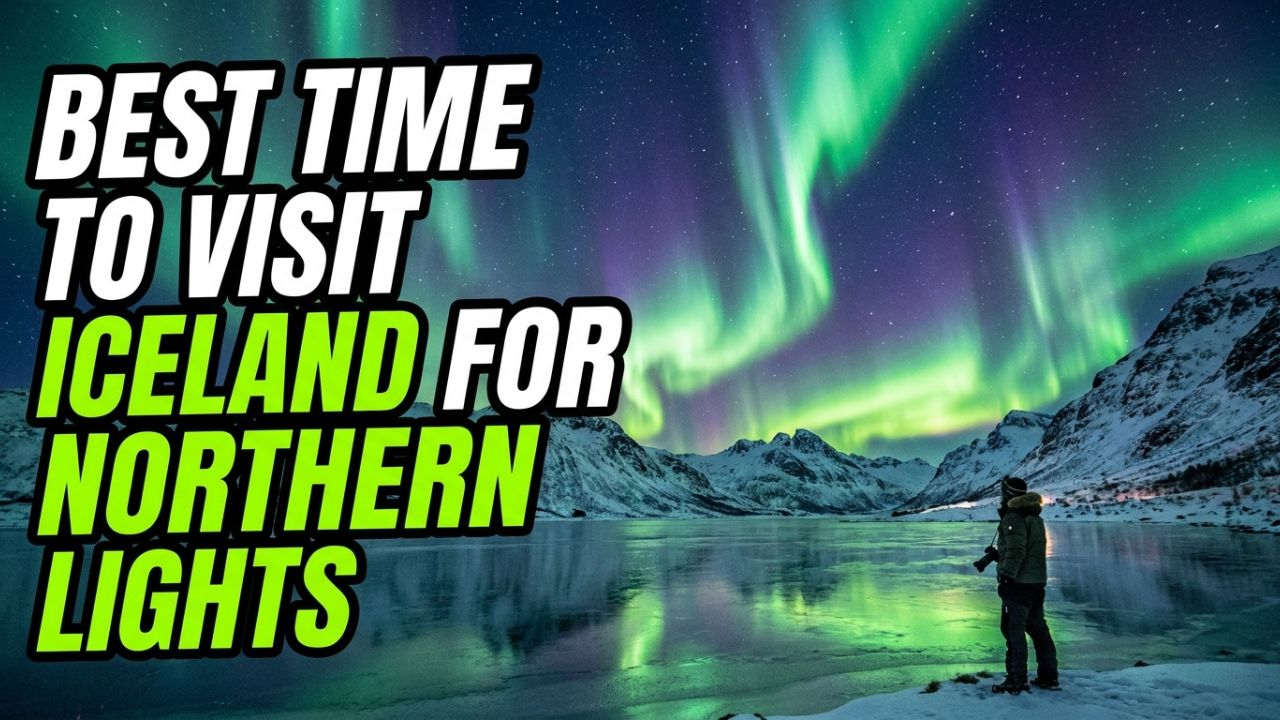
Best Time to Visit Iceland to See the Northern Lights : If you’ve been dreaming about standing under a curtain of green fire rippling across a black Arctic sky, you’re not alone. Iceland has become the northern lights destination for American travelers — and for good reason. But here’s what most generic travel sites won’t tell you: timing your trip right is everything. Show up at the wrong time of year and you’ll spend five nights staring at a cloudy, bright sky with nothing to show for it except a lighter wallet.
The best time to visit Iceland to see the northern lights is between late September and late March, when the nights are long and dark enough for the aurora to actually be visible. That’s the window. But within that window, there’s a huge difference between a good trip and a life-changing one. Let me break it all down for you the way a friend who’s actually been there would.
Best Time to Visit Iceland to See the Northern Lights
| Detail | Info |
|---|---|
| Country | Iceland |
| Nearest Major City | Reykjavik (capital) |
| Language | Icelandic (English widely spoken) |
| Currency | Icelandic Króna (ISK) — $1 USD ≈ 138 ISK (2026 est.) |
| Time Zone | GMT+0 (no daylight saving time) |
| Visa Requirements | US citizens do not need a visa for stays under 90 days |
| Best Duration of Stay | 7–10 days for northern lights + sightseeing |
Why Iceland Is the Best Place in the World to Chase the Aurora
Iceland sits right in the middle of the auroral oval — the band around the Earth’s magnetic poles where solar wind particles collide with the atmosphere and produce that unforgettable light show. You don’t have to travel as far north as Svalbard or Tromsø in Norway to get a great show. Iceland gives you the aurora and one of the most dramatic landscapes on the planet: black sand beaches, geysers, lava fields, glacier lagoons, and waterfalls that make the drive between spots feel like a screensaver.






The country also has a well-developed tourism infrastructure that makes solo travel or first-timer travel genuinely doable. English is everywhere. Car rentals are easy to find. And the ring road (Route 1) loops around the entire island, making it simple to position yourself away from city light pollution on any given night.
That said, Iceland is not forgiving of bad planning. The weather changes fast — and I mean fast. A clear sky can cloud over in 20 minutes. Which is exactly why the month and season you choose matters more than almost any other decision you’ll make for this trip.
Iceland Seasonal Travel Guide: Month-by-Month Breakdown
| Month/Season | Weather | Crowd Level | Best For |
|---|---|---|---|
| September–October | Cool, 35–50°F, mix of clear & rainy nights | Moderate (dropping fast) | First northern lights views + fall colors + waterfalls at peak flow |
| November–December | Cold, 25–40°F, frequent storms | Low (except Christmas week) | Dark skies, fewer crowds, cozy atmosphere, good aurora odds |
| January–February | Very cold, 20–35°F, stable high pressure periods | Low (cheapest flights) | Best chance of clear aurora nights, ice caves open, snow landscapes |
| March | Warming slightly, 28–42°F, increasing daylight | Picking up | Last chance for northern lights before nights get too short |
The Best Month to Visit Iceland to See the Northern Lights
If I had to pick one month and one month only, I’d say January or February. Here’s why.
December sounds romantic — Christmas markets in Reykjavik, fairy lights on every street — but it’s also the month with the most storms. The North Atlantic batters Iceland relentlessly through December, and cloudy nights are the enemy of northern lights viewing. You can still see the aurora in December, especially in the second half of the month once the holiday crowds leave, but the weather odds are stacked against you.
January and February sit in a sweet spot. The nights are still extremely long — you’re getting 18 to 20 hours of darkness around the solstice, and 15 to 17 hours by late February. High-pressure systems from the Arctic are more common in these months, meaning more clear sky nights. Temperatures drop, yes, but that’s a worthy trade when you’re watching ribbons of purple and green dance over a frozen lagoon.
February has one extra bonus: the Jökulsárlón glacier lagoon ice caves are at their best. These ice caves inside Vatnajökull glacier are only accessible from November through March, and in February the ice formations are at peak beauty — neon blue ceilings that look like being inside a sapphire. Pair that with aurora hunting at the lagoon itself, and you’ve got a bucket-list trip that most people only see in magazine covers.
September and October are brilliant choices if you want the northern lights and milder weather. The landscape in early fall is stunning — rust and amber heather across the lava fields, waterfalls at full roar after summer rains, and the aurora season just kicking in. The crowds are thinning from summer but haven’t fully disappeared, which means prices are still a bit high but the roads aren’t empty either.
Best Time to Visit Iceland to See the Northern Lights in 2026
Planning specifically for 2026? Here’s what you need to know.
We’re currently in Solar Cycle 25, and it’s been more active than predicted. The sun hit solar maximum in 2025, meaning the aurora activity in 2025–2026 should remain elevated compared to a few years ago. More solar activity = stronger and more frequent northern lights displays. This is genuinely good news for aurora chasers.
The practical implication: even during a night with average cloud cover, if a strong solar storm (G2 or higher on the NOAA scale) hits while you’re in Iceland, you might see the aurora breaking through patchy clouds. That happens more often near solar maximum. Check NOAA’s Space Weather Prediction Center before and during your trip — they publish 3-day aurora forecasts that are free and accurate.
For 2026 specifically, the windows I’d target are:
- Late September to mid-October 2026 — equinox aurora enhancement (the geomagnetic field is more favorable around the equinoxes), fall colors, relatively mild
- January 15 to February 20, 2026 — deepest dark skies, best weather stability odds, ice caves still open
- Early March 2026 — second equinox window approaching, nights still long enough, costs sometimes drop
Book your flights and rental car early for any of these windows. Iceland’s tourism has rebounded hard since 2022 and rental car availability in winter is genuinely tight in January and February.
Where to Go to Actually See the Northern Lights
Here’s the mistake I almost made on my first time: staying in Reykjavik and hoping to see the aurora from the city. Reykjavik has significant light pollution. On a mild night, you might catch a faint green glow from the harbor, but the full experience — the kind where the lights fill the whole sky and you feel genuinely small — requires getting away from city lights.
The good news is you don’t have to go far. Even 30 to 40 minutes outside Reykjavik, the sky opens up dramatically. Some spots I’d point you toward:
- Þingvellir National Park — 45 minutes from Reykjavik, UNESCO World Heritage site, dark skies, and you’re standing in the rift valley between the North American and Eurasian tectonic plates
- Jökulsárlón Glacier Lagoon — 4.5 hours from Reykjavik on the south coast, absolutely otherworldly when ice floats glow under the aurora
- Snæfellsnes Peninsula — 2 hours north of Reykjavik, the glacier volcano Jules Verne wrote about, almost no light pollution on the western tip
- Vík — a small village on the south coast with black sand beaches and dramatic sea stacks; the dark skies here are exceptional
One thing I learned the hard way: always have a backup plan. If your primary viewing spot is cloudy, be ready to drive. Iceland’s ring road makes it entirely possible to chase clear sky patches — you can cover 60 to 100 miles in an hour on a good road night and go from clouds to stars. Download the Vedur.is app (Iceland’s official weather service) and the Aurora Forecast app before you land.
How to See the Northern Lights: Practical Tips That Actually Work
Let me be straight with you — there is no guaranteed northern lights viewing. Anyone selling you a “guaranteed aurora tour” is using the word loosely. What you can do is stack the odds in your favor.
- Stay for at least 5 to 7 nights. This is non-negotiable. If you try to squeeze a northern lights trip into 3 nights, you’re gambling. Five to seven nights gives you enough attempts to realistically catch a clear night with decent solar activity. Most dedicated aurora chasers plan for 7 to 10 nights for best time of year results.
- Check the KP index. The KP index runs from 0 to 9 and measures geomagnetic activity. In Iceland, you can see the aurora at KP2 or higher on a clear, dark night. KP4 and above means a strong display visible even with some clouds. The apps mentioned above show real-time KP readings.
- Get away from the moon. A full moon is almost as bad as light pollution — it washes out faint aurora displays. Plan your prime viewing nights around the new moon phase. This is a free optimization that most people never think about.
- Stay up late. Aurora activity peaks between 10pm and 2am local time. If you’re going to bed at 9pm, you’re probably missing the show. Set an alarm for midnight. It’s worth the lost sleep.
- Dress for actual Arctic conditions. You’ll be standing outside, often in wind, for hours. Thermal base layer, mid-layer fleece, waterproof outer shell, insulated waterproof boots, wool socks, hand warmers, a balaclava. This is not the time to be fashionable.
Have you chased the northern lights before — either in Iceland or somewhere else? I’d love to know what worked for you and what you wish you’d known before going. Drop it in the comments.
Is It Okay to Wear Jeans in Iceland?
This comes up constantly from first-time visitors and it’s worth addressing directly: jeans are fine for daytime sightseeing in Reykjavik or visiting the Blue Lagoon. But for outdoor aurora hunting at night in January or February? Jeans are genuinely a bad idea.
Denim has almost zero insulating value and soaks through fast in rain or wet snow. When you’re standing outside at midnight in 25°F weather with a 20 mph wind, wet jeans will have you retreating to the car in 10 minutes. Instead, pack:
- Waterproof hiking pants or softshell trousers
- Thermal leggings underneath for extreme cold
- Snow pants if you’re going anywhere near glaciers or ice caves
Save the jeans for dinner in Reykjavik. Your comfort on aurora nights depends on it.
What Is the Number One Attraction in Iceland?
Ask ten Iceland travelers and you’ll get ten different answers, which tells you something good about the country. But if there’s one place that consistently stops people in their tracks, it’s the Golden Circle — the route that hits Þingvellir National Park, the Geysir geothermal area (where the Strokkur geyser erupts every 5 to 10 minutes), and Gullfoss waterfall.
You can do the Golden Circle in a single day from Reykjavik. Most people do it as a daylight activity and then position themselves in the Þingvellir area at night for aurora viewing — killing two birds with one stone.
A close second would be Jökulsárlón glacier lagoon. Nothing quite prepares you for the scale of it — massive icebergs calving off Breiðamerkurjökull glacier, drifting slowly to the sea, with seals lounging on them. Under the northern lights, it’s one of the most surreal things I’ve ever seen.
The Blue Lagoon is famous and worth doing, but it’s essentially a geothermal spa — stunning and relaxing, but not the same category of raw natural wonder as those two.
Why Is Iceland So Expensive?
Let’s talk money, because Iceland will genuinely surprise your wallet if you’re not prepared.
Iceland imports almost everything that isn’t fish, lamb, or geothermal energy. That means food, gas, and goods cost significantly more than in the continental US. A sit-down dinner in Reykjavik will run you $40 to $70 per person before drinks. Gas is around $8 to $9 per gallon. A coffee is $6 to $8.
Some honest cost estimates for an Iceland trip (per person, 7 nights):
- Flights from major US cities: $600–$1,100 round trip (cheaper from east coast)
- Car rental (4WD recommended in winter): $80–$150/day
- Accommodation: $120–$250/night depending on hotel vs. guesthouse
- Food: $60–$100/day eating out, $30–$50 if you grocery shop
- Activities and tours: $50–$200 each (ice cave tours, whale watching, etc.)
Total realistic budget: $2,500–$5,000 per person for a week, not including the Blue Lagoon ($100+ entry) or gear purchases.
Ways to reduce costs: stay in guesthouses or Airbnbs instead of hotels, buy lunch and breakfast groceries from Bonus or Kronan supermarkets, travel in January or February when flights and hotels drop considerably compared to peak summer or December.
How Far Is Reykjavik from the Northern Lights?
Technically, the northern lights aren’t a place — they’re a phenomenon. So the question is really about light pollution and dark sky access from Reykjavik.
As mentioned, you need about 30 to 45 minutes of driving outside the city to reach genuinely dark skies. The best close-to-Reykjavik spots include Þingvellir National Park (45 min), Nesjavellir area (40 min), and Ölfusá river valley (30 min).
If Reykjavik is your base for the whole trip, you can absolutely aurora-hunt from a day trip radius. Just be ready to drive, watch the forecast closely, and not plan anything for the next morning so you can stay out late if the sky cooperates.
For the best viewing, staying somewhere along the south coast — between Selfoss and Höfn — puts you in dark-sky territory every night without needing to drive out from the city.
Best Time to Visit Iceland to See the Northern Lights FAQ
Q : What month is best for Iceland’s Northern Lights?
Ans – January and February offer the best combination of long dark nights, relatively stable Arctic high-pressure weather systems, and lower crowds. September and October are strong alternatives with milder temperatures and the equinox aurora enhancement effect that boosts display frequency.
Q : What is the cheapest month to visit Iceland?
Ans – January is consistently the cheapest month for flights and accommodation. Prices can drop 30 to 50% compared to summer or December holiday rates. You’re also getting excellent northern lights conditions, making it one of the best value months of the entire year.
Q : How many days do you need in Iceland to see the Northern Lights?
Ans – Plan for at least 5 to 7 nights dedicated to aurora hunting. This gives you enough attempts across different weather windows to realistically catch a clear night with good geomagnetic activity. If you can only do 3 nights, understand you’re gambling — it might work, it might not.
Q : Is Iceland safe for solo female travelers?
Ans – Iceland consistently ranks as one of the safest countries in the world and is excellent for solo female travelers. Crime rates are extremely low, English is everywhere, and the travel community is generally respectful and well-organized. The main safety considerations are environmental — weather, road conditions, and staying on marked trails near geothermal areas.
Q : What is the best month to go to Iceland overall?
Ans – For northern lights, January or February. For hiking, puffins, and midnight sun, June or July. For a balance of decent weather, aurora viewing, and manageable crowds, September or October is the sweet spot that experienced Iceland travelers often recommend.
Q : How far is Reykjavik from the Northern Lights viewing areas?
Ans – You can reach proper dark-sky viewing spots in 30 to 45 minutes by car from central Reykjavik. No need to travel to the far north of Iceland — the aurora oval covers all of Iceland during active nights. The key is getting away from Reykjavik’s light pollution, not traveling to a specific northern location.
One Last Thing Before You Book
The northern lights are one of those experiences that changes people in a way that’s hard to explain until it happens to you. I’ve seen them twice now, and the second time — standing on a black sand beach in February with snow on my boots and green light sweeping overhead — I genuinely couldn’t speak for a few minutes.
But here’s what I want you to remember: the aurora is the main event, but Iceland is the whole show. Even on cloudy nights when the lights don’t appear, you’re still in one of the most dramatic places on Earth. The waterfalls, the thermal pools, the lava fields, the food, the silence — it all adds up to something that has nothing to do with weather forecasts.
So plan for the aurora. Optimize for the best months, check the KP index obsessively, drive away from city lights at midnight. And then let Iceland surprise you with everything else it has to offer.
For the latest US travel advisories before your trip, check travel.state.gov — Iceland is currently listed as a Level 1 destination (exercise normal precautions), which is about as safe as it gets.
What’s your biggest hesitation about booking an Iceland trip? Is it the cost, the cold, or figuring out the logistics? Tell me in the comments — I genuinely want to help you get there.