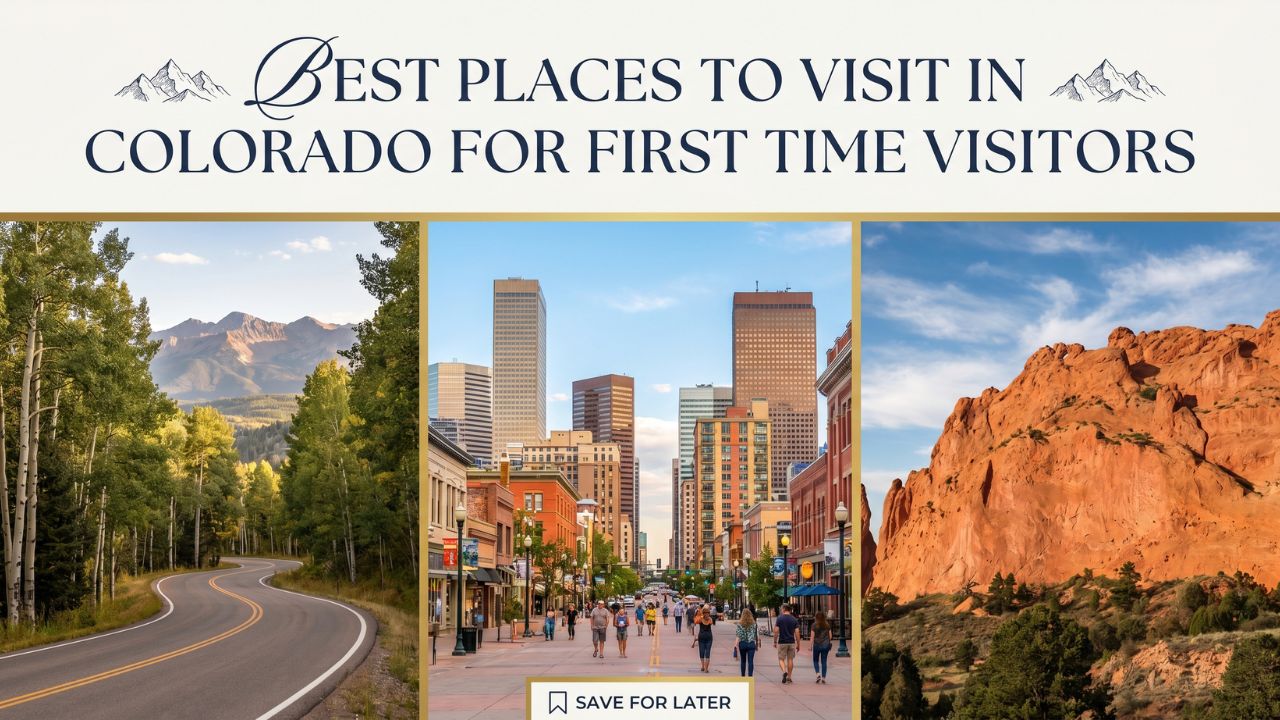
Best Places to Visit in Colorado for First Time Visitors – I still remember the exact moment I crossed into Colorado from Kansas on I-70 — the flat horizon suddenly cracked open and the Rocky Mountains appeared in the windshield like a painting someone had hung right there on the edge of the sky. That was my first time visiting, and I completely lost my ability to speak for about three seconds. If you’re planning your first trip to Colorado, get ready for a very similar reaction.
Colorado is the kind of state that makes you rethink everything you thought you knew about what America looks like. Whether you’re into skiing, hiking through wildflower meadows, exploring charming mountain towns, tasting craft beer after a long trail day, or just sitting on a deck with a view that goes on forever — Colorado delivers every single time. This guide is your no-fluff, American-traveler-approved breakdown of the best places to visit in Colorado for the first time, with honest costs, real tips, and the kind of local knowledge that doesn’t show up on the first page of Google.
Best Places to Visit in Colorado for First Time Visitors
| Detail | Information |
|---|---|
| Country | United States of America |
| State Capital | Denver |
| Region | Mountain West |
| Currency | US Dollar ($) |
| Time Zone | Mountain Time (MT) — UTC-7 in summer, UTC-6 in winter |
| Language | English |
| Visa Requirements | No visa needed for US citizens |
| Best Duration of Stay | 7–14 days for a solid first visit |
| State Size | 8th largest state in the US |
Why Colorado Stopped Me in My Tracks
There are 50 states in this country and I’ve been to most of them. None of them hit quite like Colorado on a clear September morning when the aspen trees have gone gold and the air smells like pine and cold water.
 My Little Babog Family Lifestyle Travel Blog
 Budget Travel Tips for Expensive Cities USA
 Cheapest Month to Fly to New York
 What Is the Cheapest Month to Fly to Puerto Rico
 15 Best Place & Best Time to Travel to Puerto Rico
 Best Italian Places to Travel: The Only Guide You’ll Need Before Booking Your Flight
The thing that separates Colorado from other mountain destinations — places like the Smokies or the Cascades — is the sheer variety of experiences packed into a single state. You can wake up in Denver, one of America’s most livable cities, drive two hours, and be standing at 14,000 feet above sea level on a peak that makes the Alps look average.
Colorado also pulls off something rare: it appeals equally to the outdoor adventure crowd, the foodie and culture crowd, and the families-with-kids crowd. You don’t have to compromise. A ski resort town like Telluride is also a world-class film festival destination. A sleepy mountain town like Ouray has hot springs and Victorian architecture. Rocky Mountain National Park is a national treasure that still somehow feels personal and unhurried in the right season.
If you’re wondering where to visit in Colorado for the first time, the honest answer is: it depends on what drives you. But this guide covers every type of traveler, so keep reading.
Best Time to Visit Colorado for the First Time
Colorado has four distinct seasons and each one turns the state into a completely different kind of destination. Unlike a lot of places where there’s one “right” time to go, Colorado is genuinely spectacular year-round — you just need to match the season to your goals.
| Month / Season | Weather | Crowd Level | Best For |
|---|---|---|---|
| January – February | Cold, heavy snow in mountains (lows 15–30°F in ski towns) | High at ski resorts | Skiing, snowboarding, cozy mountain lodge vibes |
| March – April | Warming slowly, spring snowstorms possible, Denver is mild | Moderate | Late ski season deals, shoulder-season hiking |
| May – June | Warm days (65–80°F in Denver), cool in mountains, wildflowers start | Growing quickly | Wildflower season, waterfalls, trails opening up |
| July – August | Peak summer, 85–95°F in Denver, 60–75°F in mountains | Peak — highest crowds | Hiking, festivals, outdoor concerts, camping |
| September – October | Ideal temperatures, aspen leaf season (gold foliage in late Sept) | Moderate-high in late Sept | Single best time for first-timers — less crowded than summer, stunning foliage |
| November – December | Early ski season, Thanksgiving weekend rush, Denver holiday events | Moderate | Skiing, holiday markets, fewer tourists than January |
My honest pick for a first-time visit: late September to mid-October. The summer crowds thin out dramatically after Labor Day, prices drop, the aspens turn golden (it’s genuinely one of the most beautiful natural events in North America), and the weather is cool but comfortable for hiking and exploring towns.
If you’re coming for skiing, January and February give you the best snow conditions, but also the highest resort prices.
Have you visited Colorado in the off-season? I’d love to hear in the comments whether September felt worth it to you or if you prefer the summer buzz.
Best Places to Visit in Colorado for the First Time
Here are the best places to visit in Colorado for the first time, organized from the most iconic to the hidden-gem end of the spectrum. Each one earns its spot on this list for a different reason.
1. Denver — Colorado’s Front Door and a City That Keeps Surprising You
Denver is where most first-time Colorado visitors land, and a lot of people make the mistake of treating it as a layover city before heading to the mountains. That’s a genuine shame, because Denver has become one of the most interesting mid-sized cities in America.
My Little Babog Family Lifestyle Travel Blog
Budget Travel Tips for Expensive Cities USA
Cheapest Month to Fly to New York
What Is the Cheapest Month to Fly to Puerto Rico
15 Best Place & Best Time to Travel to Puerto Rico
Best Italian Places to Travel: The Only Guide You’ll Need Before Booking Your Flight
The 16th Street Mall in downtown Denver is a free shuttle-connected pedestrian corridor lined with restaurants, shops, and people-watching opportunities. But the real Denver experience is in the neighborhoods. RiNo (River North Art District) is a converted warehouse district full of murals, craft breweries, and restaurants that punch well above their weight — some of the best tacos I’ve had anywhere in the country came from a tiny spot in RiNo.
The Denver Art Museum in the Civic Center neighborhood is unexpectedly fantastic, especially for its Indigenous art collections. The Denver Botanic Gardens in the Cheesman Park neighborhood is a gem that even longtime Denver residents overlook.
Denver also sits at exactly 5,280 feet above sea level — it’s literally called the “Mile High City” — so give yourself a day to acclimate before you head higher into the Rockies. Your body needs it, and Denver is absolutely worth spending that time in.
Budget range: Airbnb from around $90–$150/night, decent downtown hotels from $130–$220/night, craft beer at $6–$9 a pint, dinner at a mid-range restaurant $18–$35 per person.
2. Rocky Mountain National Park — The Heart of Colorado’s Wild Side
If you only have one “nature day” in Colorado, Rocky Mountain National Park (RMNP) is where you spend it. Located about 65 miles northwest of Denver near the town of Estes Park, this park is one of the most visited in the entire National Park System — and for very good reason.
Trail Ridge Road runs through the park and reaches over 12,000 feet. You can drive it in a regular car, no 4WD needed, and the views from the tundra overlooks will make you question every other vacation you’ve ever taken.
The Bear Lake area is the park’s most accessible and most photographed zone, with a paved half-mile loop around Bear Lake that even young kids can handle. But if you want something more rewarding, the hike from Bear Lake to Nymph Lake, then Dream Lake, then Emerald Lake is one of the best short hike sequences in the country — about 3.6 miles round trip, relatively easy, and the payoff at Emerald Lake is staggering.
Wildlife spotting is outstanding here. Elk are almost guaranteed in fall, especially around Moraine Park and near Estes Park itself during the rut in September and October. Moose, mule deer, black bears, and even mountain lions (rarely seen) all live in the park. <div class=”tip-box”><strong>Pro Tip:</strong> RMNP now requires timed entry permits from late May through mid-October. Permits go fast — often within minutes of the reservation window opening. Book yours at recreation.gov well in advance or plan to arrive before 6 AM when the permit requirement doesn’t apply yet.</div>
Entry fee: $35 per vehicle (valid for 7 days), or use an America the Beautiful Annual Pass ($80) which covers all national parks — an incredible deal if you’re hitting more than two parks in a year.
3. Aspen — One of America’s Most Glamorous Mountain Towns
Aspen has a reputation as a billionaire’s playground, and yes, it earned that reputation. But here’s what most people don’t know: you can visit Aspen on a real-person budget if you’re smart about it.
In summer, Aspen transforms from a ski destination into one of the best places to hike in Colorado. The Maroon Bells — a pair of jagged twin peaks reflected in Maroon Lake — are simply the most photographed mountains in North America and they’re located about 10 miles outside of Aspen. Seeing them at sunrise is not a cliché recommendation. It’s a legitimate life experience. The light hits the rust-red rock faces at around 7 AM and turns the entire scene into something that doesn’t look real.
Aspen’s downtown is also genuinely beautiful — Victorian-era buildings, galleries, serious restaurants, and a pedestrian energy that feels European. You don’t have to stay in the ultra-luxury hotels to walk around and enjoy it.
Where to stay on a budget in Aspen: The St. Moritz Lodge is a throwback property with reasonable rates (from around $150–$250/night in summer) that’s been there since the 1950s. Alternatively, base yourself in Basalt (20 miles down valley) where Airbnbs run $80–$130/night and you commute in by bus or car.
4. Telluride — The Switzerland of America
Telluride is the answer to the question “What is the most beautiful town in Colorado?” — and also the answer to the question the title gives away: the town in Colorado called the Switzerland of America. Sitting in a box canyon at 8,750 feet, surrounded on three sides by 14,000-foot peaks with waterfalls spilling down canyon walls, Telluride looks like someone designed it specifically to make you feel overwhelmed.
The free gondola that connects downtown Telluride to the Mountain Village above is one of the best perks in Colorado travel — it runs year-round and offers views that most resorts charge lift ticket prices to see. Take it up in the evening when the light goes warm on the canyon walls.
Bridal Veil Falls, at the far end of the valley, is Colorado’s tallest free-falling waterfall and it’s an easy 1.5-mile walk from downtown. The road that winds up beside it leads to a historic hydroelectric plant that still operates today.
Telluride also hosts some of the country’s most acclaimed festivals, including the Telluride Film Festival (Labor Day weekend) and the Telluride Bluegrass Festival (June). If you can time your visit around one of them, the energy is absolutely incredible.
Budget note: Telluride is expensive. Expect to pay $200–$500+/night for lodging during festivals or ski season. The shoulder months of May and October are your budget windows.
5. Mesa Verde National Park — A Cultural Marvel Unlike Anything Else in America
Most people build their Colorado itinerary around mountains and ski towns. Mesa Verde National Park, in the southwestern corner of the state, is the wildcard that earns its place on every first-timer’s itinerary.
Mesa Verde protects the most remarkable collection of Ancestral Puebloan cliff dwellings in the United States. The Cliff Palace — a 150-room stone complex built into a natural alcove 700 years ago — is not just visually stunning, it’s genuinely humbling. The people who built this were sophisticated engineers, artists, and farmers, and standing inside their homes puts American history in a completely different perspective.
Ranger-guided tours of Cliff Palace and Balcony House run from late spring through fall and cost $5–$8 per person on top of park admission. They’re worth every cent. You’ll actually climb ladders and crawl through tunnels inside the dwellings. Kids absolutely love this.
Park entry: $30 per vehicle. The nearest airport is Durango, about 36 miles away.
6. Durango — Colorado’s Most Underrated Town for Families
Durango consistently flies under the radar, but it’s one of the best places to visit in Colorado for families and budget travelers alike. Situated on the Animas River in the San Juan Mountains of southwestern Colorado, Durango has the outdoor access of a major mountain town at prices that feel like 10 years ago.
The Durango & Silverton Narrow Gauge Railroad is a genuine American classic — a historic steam-powered train that runs through spectacular mountain gorges to the old mining town of Silverton. The full round trip takes about 9 hours and costs around $100–$130 per adult, $65–$75 for kids. It sounds like a lot until you’re sitting in a vintage coach watching canyon walls rise around you and the steam engine echoes off the cliffs.
Downtown Durango has excellent restaurants, local breweries (Ska Brewing is a Colorado institution), and a walkable, non-touristy energy. Lodging is genuinely affordable — mid-range hotels around $100–$150/night, Airbnbs even lower.
7. Colorado Springs — The Outdoor Hub of the Front Range
Colorado Springs is the second largest city in Colorado and one of the most underestimated destinations in the state. It sits at the base of Pikes Peak, the legendary 14,115-foot summit that inspired “America the Beautiful,” and it’s surrounded by some of the most dramatic red rock scenery in the country.
Garden of the Gods is a city-owned park (yes, totally free to enter) with massive red sandstone formations that look like they fell out of a sci-fi movie set. Sunrise at Garden of the Gods is something I’d put up against sunrise anywhere in the country. Get there at 6 AM on a weekday and you might have entire formations to yourself.
Pikes Peak itself is accessible by the Pikes Peak Cog Railway from Manitou Springs, which recently underwent a $100 million renovation and is now an absolutely world-class experience. Round trip tickets run around $42 for adults. You can also drive the Pikes Peak Highway ($15 per person) if you prefer that. The summit gift shop sells donuts, which at 14,000 feet taste like they were made by angels.
The Broadmoor is Colorado Springs’ legendary luxury resort and one of the most storied hotels in America — even if you’re not staying there, touring the grounds and having a drink at the lakeside bar is 100% worth an hour of your time.
8. Vail — The Most Polished Mountain Town in Colorado
Vail is to Colorado ski towns what Beverly Hills is to LA neighborhoods — immaculate, wealthy, and genuinely impressive in its own right. Even if you’re visiting in summer (which I’d actually recommend for first-timers who want to avoid ski season prices), Vail Village is one of the most beautifully designed pedestrian spaces in mountain America.
The Betty Ford Alpine Gardens, tucked right in the middle of Vail Village, is the highest botanical garden in North America at 8,200 feet and admission is completely free. It’s small but genuinely lovely.
For hiking near Vail, the Booth Falls Trail is one of the best moderate hikes in the entire state — 4.2 miles round trip with a stunning 60-foot waterfall payoff and elk often visible in the meadows. Easy trailhead access right from Vail.
Summer lodging in Vail runs $150–$300/night for a decent room. Ski season rates can hit $400–$800+/night in peak weeks, so unless skiing is your primary mission, summer or fall is genuinely the right call.
9. Ouray — Colorado’s Hidden Alpine Gem
Ouray sits in a natural bowl in the San Juan Mountains at 7,800 feet and has been called the Switzerland of America — though Telluride also claims that title, and honestly, both towns have a case. Ouray is smaller (population around 1,000), less famous, and significantly more affordable than its more celebrated neighbors.
The Ouray Hot Springs Pool is a natural geothermal complex right in the center of town — three pools ranging from warm to hot, set against a backdrop of canyon walls. Admission is around $15–$20 for adults. After a day of hiking, it’s exactly what your legs need.
The Ouray Ice Park in winter is a global destination for ice climbers — a naturally refrigerated canyon that’s artificially seeded each winter to create climbing routes. Even if you’re not a climber, watching people scale 100-foot ice walls from the canyon rim is genuinely mesmerizing.
The drive into Ouray on US-550 (the Million Dollar Highway) is one of the most dramatic scenic drives in America — narrow, cliff-hanging, guardrail-minimal, and spectacular. If that last part made you anxious, stay in the right lane and keep your eyes on the road. Worth it.
10. Breckenridge — The Most Charming Ski Town for First-Timers
Breckenridge (locals call it “Breck”) sits at 9,600 feet and has one of the most walkable, charming historic downtowns of any ski town in Colorado. Unlike Vail or Aspen, Breckenridge has a genuine small-town feel that doesn’t entirely evaporate in high season.
Main Street in Breckenridge is lined with Victorian-era buildings from the gold and silver mining boom of the 1880s, now housing restaurants, galleries, and boutiques. The town has leaned into its mining history without making it feel cheesy.
In summer, the Carter Park Disc Golf Course is free and genuinely fun, and the local trail network for mountain biking and hiking is excellent. The Breckenridge Brewery on Main Street serves solid beers in a historic building.
This is also one of the best places to visit in Colorado for couples — the combination of stunning mountain scenery, excellent restaurants, walkable streets, and proximity to ski lifts (or summer lift rides with mountain views) creates a genuinely romantic atmosphere.
Budget note: Breckenridge runs $150–$350/night for lodging depending on season. Ski season weeks around Christmas and Presidents Day hit the high end of that.
11. Estes Park — Gateway to the Rockies and a Town Worth Its Own Day
Most visitors treat Estes Park as a parking lot for Rocky Mountain National Park. It’s more than that. The town itself sits at 7,522 feet with stunning views in every direction and a main street that’s genuinely fun to walk — elk actually wander through downtown in September and October, which is one of those only-in-Colorado moments.
The Stanley Hotel, perched on a hill above Estes Park, is the Victorian resort that inspired Stephen King to write “The Shining.” Tours run daily, the bar serves cocktails named after the book, and yes, the hallways are legitimately a little creepy. Dinner at the Cascades Restaurant inside the Stanley is worth the price.
Estes Park Aerial Tramway offers gondola rides to the top of Prospect Mountain for sweeping views over the town and the park entrance.
12. Steamboat Springs — Cowboy Culture Meets World-Class Skiing
Steamboat Springs has a personality different from every other ski town in Colorado. It’s real Colorado cowboy country — rodeos in summer, working ranches, a livestock auction house, and a genuine agricultural identity that predates the ski resort by decades.
Strawberry Park Hot Springs, about 7 miles from downtown, is one of the most beautiful natural hot spring settings I’ve encountered anywhere in the country — rustic, clothing-optional after dark, surrounded by snow in winter and wildflowers in summer. Day access runs about $25 per person.
The Yampa River Core Trail runs through the heart of town along the river and is perfect for a morning run or afternoon bike ride. In summer, the Yampa is popular for tubing — rent an inner tube for about $15 and float through town.
13. Crested Butte — Colorado’s Wildflower Capital and Best Kept Secret
If you ask serious Colorado travelers what their favorite spot is, a lot of them say Crested Butte — and then add “but don’t tell too many people.” The town sits at 8,885 feet in a high alpine valley that sees some of the most extravagant wildflower blooms in North America from late June through August.
The Wildflower Festival in July is a legitimate bucket-list event — the meadows around town turn into carpets of blue, purple, yellow, and red that stretch to the base of the mountains. Photography opportunities are almost unfair.
Crested Butte is also one of the best places to mountain bike in Colorado — some riders actually consider it the mountain biking capital of the state.
Getting there requires either flying into Gunnison-Crested Butte Regional Airport or driving about 4 hours from Denver. The effort is absolutely worth it.
14. Great Sand Dunes National Park — The Colorado Nobody Expects
People genuinely don’t believe me when I tell them there’s a massive sand dune field in Colorado. Great Sand Dunes National Park in southern Colorado contains the tallest sand dunes in North America — some reaching over 750 feet — rising improbably against the backdrop of the Sangre de Cristo Mountains.
The experience is surreal. You can rent sleds and sand boards and ride down the dunes (full disclosure: hiking up is significantly harder than it looks), wade in the Medano Creek that flows seasonally at the base, and watch sunsets that turn the dunes amber and rose.
Entry is $25 per vehicle. The nearest town is Alamosa, about 35 miles away. This park pairs brilliantly with Mesa Verde for a southern Colorado road trip loop.
15. Silverton — Living History at 9,318 Feet
Silverton is a tiny (population about 700) historic mining town that sits at the end of the Million Dollar Highway and the Durango & Silverton railroad line. It looks like a film set from a Western, but it’s entirely real — and almost entirely unchanged from its 1880s heyday.
The whole town is a National Historic Landmark. The Blair Street historic district, the old mines accessible by jeep tours, and the backdrop of peaks over 13,000 feet make this one of those places that photographs well and experiences even better.
Silverton has no stoplights, no chain restaurants, and a full-time population that relies almost entirely on summer tourism. Your $20 lunch at a local café goes a long way here.
Where to Stay, Eat, and Get Around Colorado
Getting Around Colorado
Colorado is a drive-it-yourself state. Public transportation between most destinations is limited or nonexistent. A rental car is essentially non-negotiable for any first-time visitor who wants to explore beyond Denver.
- Denver International Airport (DIA) is the hub for most flights. Major rental car companies have desks on-site.
- I-70 westbound from Denver is the main artery into the mountains. Friday afternoon and Sunday evening traffic is brutal — avoid it.
- Mountain roads in fall and winter require checking CDOT road conditions at cotrip.org before driving. A lot of scenic routes close seasonally.
- Gas prices in Colorado run slightly above the national average, especially near mountain resort towns. Fill up before heading into the high country.
Where to Stay
| Destination | Budget Option (per night) | Mid-Range Option | Luxury Option |
|---|---|---|---|
| Denver | Hostel $35–$55, Airbnb $80–$120 | Boutique hotel $130–$200 | The Brown Palace from $280 |
| Estes Park / RMNP | Camping $30–$55, motel $100–$140 | YMCA of the Rockies from $130 | The Stanley Hotel from $220 |
| Aspen (summer) | St. Moritz Lodge from $150 | Limelight Hotel from $220 | The Little Nell from $700+ |
| Telluride (summer) | Airbnb in town $180–$260 | Hotel Telluride from $250 | The Peaks Resort from $350+ |
| Colorado Springs | Chain hotel $90–$130 | Hotel Elemental from $150 | The Broadmoor from $350 |
| Durango | Motel $85–$110 | Strater Hotel from $130 | Rochester Hotel from $180 |
Where to Eat (Honest Recommendations)
- Denver: Work & Class (American comfort food, very popular), Pho 95 (Vietnamese, genuine and cheap), Tacos Tequila Whiskey in Highlands neighborhood
- Estes Park: The Notchtop Bakery & Café for breakfast, Lonigan’s Saloon for a classic mountain dive bar
- Aspen: Cache Cache for a romantic dinner, Clark’s Oyster Bar for lunch, City Market for cheap sandwich supplies before hiking
- Durango: Ore House on Main Ave (Colorado beef done right), Steamworks Brewing for post-adventure food
- Telluride: Brown Dog Pizza (genuinely legendary for a ski town pizza joint), Butcher & the Baker for breakfast
Pro Tips and Common Tourist Mistakes to Avoid in Colorado
This is the section I wish someone had handed me before my first Colorado trip.
Altitude is real and it will humble you. Denver sits at 5,280 feet. Breckenridge at 9,600 feet. Even people in excellent physical shape feel altitude effects — headaches, fatigue, shortness of breath, disrupted sleep. Drink twice as much water as you think you need, avoid alcohol for the first 24–48 hours, and don’t plan your most intense hiking day on Day 1.
Afternoon thunderstorms are predictable in summer. From late June through August, almost every afternoon above treeline, thunderstorms roll in between 1–3 PM. Plan to be off mountain summits and above-treeline trails by noon. This is not a recommendation, it’s a safety rule. Lightning at altitude kills people every year.
The “it’s right around the corner” mountain distance illusion. That peak that looks 20 minutes away is three hours of hiking. Colorado distances are deceptive. Always check actual trail mileage and estimated time, not just how far it looks.
Don’t blow your whole budget on lodging in one resort town. Staying in a smaller adjacent town and driving in saves 30–50% on accommodation. Basalt instead of Aspen. Ridgway instead of Telluride. Lyons instead of Estes Park.
Sunscreen at altitude is non-negotiable. UV exposure increases significantly with elevation. Burn in Colorado is faster and nastier than at sea level, even on cloudy days.
Reservations matter more than ever. Top restaurants in Aspen, Telluride, and Vail book 2–4 weeks ahead in peak season. Same for timed-entry national park permits, gondola rides, and popular guided tours.
Don’t skip the less-famous southern Colorado. Most first-timers stay in the Denver-to-Vail corridor. The Durango/Telluride/Mesa Verde triangle in southwestern Colorado is equally spectacular and significantly less crowded.
What’s the biggest travel mistake you’ve made in a mountain destination? Drop it in the comments — your story might save someone else from the same headache.
Budget Breakdown: What to Actually Expect to Spend in Colorado
One of the most common questions about Colorado travel is: how expensive is it really? The honest answer is that Colorado has an enormous range — from genuinely cheap to legitimately extravagant — and your experience will be shaped almost entirely by when you go and where you stay.
Sample Daily Budgets for Different Traveler Types
| Traveler Type | Daily Budget (per person) | What That Gets You |
|---|---|---|
| Budget traveler | $80–$120/day | Camping or hostel, cooking some meals, free trails and parks, state park fees |
| Mid-range traveler | $180–$280/day | Mid-range motel/Airbnb, restaurant dinners, national park fees, one or two paid activities |
| Comfortable traveler | $300–$500/day | Boutique hotel, good restaurants, guided tours, ski lift tickets or premium activities |
| Splurge traveler | $600–$1,200+/day | Luxury mountain resort, fine dining, helicopter tours, high-end ski passes |
Specific Cost Benchmarks
- National park day pass: $25–$35 per vehicle
- Rocky Mountain National Park timed entry permit: Free (on top of park entry)
- Ski lift tickets: $120–$200+ per day at major resorts in peak season. (Buy in advance — same-day window prices are brutal.)
- Durango & Silverton Railroad: ~$100–$130 adult round trip
- Maroon Bells shuttle (required in peak season): $16 per person
- Average Colorado craft beer: $6–$9 per pint
- Average burger and fries in a mountain town: $16–$22
- Grocery store sandwich and trail snacks for a hiking day: $10–$15
Money-Saving Tips
- The America the Beautiful Annual Pass at $80 covers all national parks and many national monuments for a year. Buy it at your first park and it pays for itself in two visits.
- Colorado State Parks Pass ($80/year) covers 41 state parks with free day-use access.
- Summer and fall shoulder-season accommodation runs 20–40% less than peak ski weeks.
- Free camping on National Forest land (dispersed camping) is legal throughout most of Colorado’s national forests with no permit and no fee.
How to Plan Your Colorado Itinerary: Sample Schedules for First-Timers
Here are two real-world itineraries built around the way most Americans actually travel to Colorado — by flying into Denver.
7-Day Colorado Road Trip for First-Timers
Day 1 — Denver Arrive, acclimate, explore RiNo or the Highlands neighborhood, dinner at a local restaurant. Do not push yourself physically on Day 1.
Day 2 — Rocky Mountain National Park / Estes Park Drive to Estes Park (1.5 hours). Morning permit entry to RMNP, Bear Lake to Emerald Lake hike. Elk watching in Moraine Park at dusk. Stay overnight in Estes Park.
Day 3 — Rocky Mountain National Park / Drive to Breckenridge Morning: Trail Ridge Road drive if open. Afternoon: drive south on US-36 to I-70 west to Breckenridge (about 2.5 hours). Evening walk on Main Street Breckenridge.
Day 4 — Breckenridge / Vail Morning hike above Breckenridge or a lift ride for views. Afternoon drive to Vail (45 minutes). Booth Falls Trail hike. Overnight Vail or nearby Edwards.
Day 5 — Aspen / Maroon Bells Drive to Aspen (1.5 hours from Vail). Early morning Maroon Bells shuttle (book ahead). Afternoon explore Aspen downtown.
Day 6 — Colorado Springs Drive south from Denver area (2 hours). Morning: Garden of the Gods. Afternoon: Pikes Peak Cog Railway or highway.
Day 7 — Return to Denver / Depart Morning: final Denver exploration (Denver Art Museum or Botanic Gardens). Afternoon departure flight.
10-Day Southern Colorado Loop (Less Crowded, Equally Spectacular)
Days 1–2: Denver (explore city, acclimate) Day 3: Drive to Colorado Springs, Garden of the Gods, Pikes Peak Day 4: Drive to Great Sand Dunes National Park (3.5 hours), sand dune hiking/sledding, overnight near Alamosa Day 5: Drive to Durango (3 hours), evening on Main Ave Day 6: Durango & Silverton Narrow Gauge Railroad full day Day 7: Drive to Telluride (1.5 hours), Bridal Veil Falls, gondola ride Day 8: Telluride hiking or exploring, afternoon drive to Ouray Day 9: Ouray Hot Springs, Million Dollar Highway drive, Mesa Verde National Park Day 10: Drive back to Denver via Pueblo (4.5 hours), evening departure
Best Places to Visit in Colorado for First Time Visitors FAQ
Q : What is the #1 attraction in Colorado?
Ans – Rocky Mountain National Park draws the most visitors of any single attraction in Colorado, and for good reason. Trail Ridge Road, the Bear Lake area, and the wildlife viewing during elk rut season in September and October make it genuinely unmissable. Garden of the Gods in Colorado Springs is a close second and is entirely free.
Q : What is the most beautiful part of Colorado?
Ans – The San Juan Mountains in southwestern Colorado — encompassing Telluride, Ouray, Silverton, and the Million Dollar Highway — are widely considered the most visually dramatic part of the state. The combination of 14,000-foot peaks, waterfalls, and Victorian-era mining towns is unlike anything else in America.
Q : What town in Colorado is called the Switzerland of America?
Ans – Ouray is most commonly referred to as the “Switzerland of America” due to its location in a natural alpine bowl surrounded by jagged peaks. Telluride also earns that comparison. Both towns are in the San Juan Mountains in southwestern Colorado.
Q : How do you spend 3 days in Colorado?
Ans – Day 1 in Denver to acclimate and explore. Day 2 at Rocky Mountain National Park from Estes Park — Bear Lake trail and Trail Ridge Road. Day 3 in Colorado Springs at Garden of the Gods and Pikes Peak. This hits the three most iconic Front Range experiences without requiring a car rental for long mountain highway drives.
Q : What town in Colorado looks like a Hallmark movie?
Ans – Breckenridge is the most frequently cited answer — the Victorian storefronts on Main Street, string lights in winter, mountain backdrop, and cozy café culture genuinely look like a Hallmark set. Estes Park also fits this description, particularly around the holidays. Ouray is another strong contender.
Q : What are the top 5 cities in Colorado by population?
Ans – Denver (largest city and state capital), Colorado Springs, Aurora, Fort Collins, and Lakewood round out the top five. For travel purposes, Denver, Colorado Springs, Fort Collins, and Pueblo are the most relevant urban bases. Most mountain resort “towns” like Aspen, Telluride, and Breckenridge are technically very small towns rather than cities.
Q : What are three things Colorado is famous for?
Ans – Colorado is most famous for skiing and mountain recreation (home to some of the best ski resorts in the world), its concentration of “fourteeners” (mountains over 14,000 feet — Colorado has 58 of them), and its craft beer scene (Colorado consistently ranks among the top states in the country for craft brewing).
Q : Is Colorado safe for solo travelers?
Ans – Colorado is generally very safe for solo travelers, including solo female travelers. The main safety considerations are outdoor-related — altitude sickness, afternoon lightning, trail navigation, and wildlife awareness — rather than crime. Denver and Colorado Springs have areas to avoid after dark, as most cities do, but popular tourist areas are safe and well-traveled.
Reference Resources
For up-to-date travel advisories, road conditions, and entry requirements when visiting Colorado:
- US State Department Travel Information: travel.state.gov for any international visitors needing visa guidance
- Colorado Department of Transportation Road Conditions: cotrip.org — essential for mountain driving in fall and winter
- Recreation.gov for national park permit reservations, campsite bookings, and activity permits throughout Colorado
This article reflects personal travel experience and current knowledge as of 2026. Prices, hours, and permit requirements can change — always verify directly with the venue or park before your visit.
Originally published on hillsfordconsulting.com
Tags: